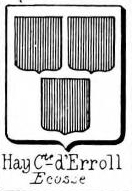
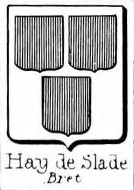
(Earl of Erroll. “In the reign of Kenneth III.,” says Douglas, “about 980, the Danes having invaded Scotland, were encountered by that King near Loncarty, in Perthshire; the Scots at first gave way, and fled through a narrow pass, where they were stopped by a countryman of great strength and courage, and his two sons, with no other weapons than the yokes of their ploughs; upbraiding the fugitives for their cowardice, he succeeded in rallying them; the battle was renewed, and the Danes totally discomfited. It is said that after the victory was obtained, the old man lying on the ground, wounded and fatigued, cried ‘Hay, Hay;’ which word became the surname of his posterity; the King, as a reward of that signal service, gave him as much land in the Carse of Gowrie as a falcon should fly over before it settled; and a falcon being accordingly let off, flew over an extent of ground six miles in length, afterwards called Errol, and lighted on a stone, still called Falcon-stone; the King also assigned three shields or escutcheons for the arms of the family, to intimate that the father and the two sons had been the three fortunate shields of Scotland.” This legend, first told by Hector Boece, was invented to explain the arms, which are at least as old as 1292, and in turn suggested the crest, motto, and supporters). Ar. three escutcheons gu. Crest—A falcon rising ppr. Supporters—Two men in country habits, each holding an ox-yoke over the shoulder ppr. Motto—Serva jugum.
(Fudie, co. Aberdeen). Ar. a chev. sa. betw. three inescutcheons gu.
(Seafield, co. Aberdeen). Ar. a chev. betw. three inescutheons gu. Crest—An increscent ppr. Motto—Donee impleat orbem.
(Dalgety and Ardendraght, co. Aberdeen; descended from a second brother of the first Earl of Erroll; heiress m. Cuthbert, of Castlehill). Ar. a cinquefoil az. betw. three inescutheons gu.
(Sir David Hay, physician; descended of Dalgety, 1692). Ar. three inescutheons gu. within a bordure az. charged with six frases ar. Crest—An ox-yoke with a serpent entwined round it all ppr. Motto—Fortius dum juneta.
(Letham; from Dalgety, 1693). Ar. three inescutcheons gu. within a bordure indented az. charged with three frases of the field. Crest—An ox-yoke entwined with laurel and olive ppr. Motto—Fert laurea fides.
(Cardenie; from Dalgety). Ar. a fess nebuly betw. three inescutcheons gu. Crest—An ox-yoke erected in pale gu. Motto—Hinc honor et opes.
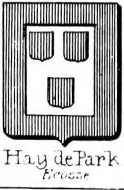
(Park, co. Wigtoun, bait., 1663). Ar. three inescutcheons within a bordure gu. Crest—A falcon displ. ppr. Motto—Serva jugum.
(Dalrymple-Hay, of Park Place, bart.). See Dalrymple.
(Leys, co. Perth; from a younger son of the first William de Hava, of Erroll). Erm. three inescutheons gu. Crest—A stag’s head cabossed ppr.
(Paterson-Balfour-Hay, of Leys and Randerson, 1872). Quarterly, 1st and 4th, as the last; 2nd, or, on a chev. sa. betw. two trefoils vert in chief, and a garb in base of the last, banded of the first, an otter’s head erased sa., for Balfour; 3rd, ar. three pelicans feeding their young ppr. in nests vert, on a chief gu. three crescents of the first, for Paterson. Crests—A Lowland Scots countryman, demi figure vested grey, waistcoat gu. bonnet az. and feather ppr. bearing on his right shoulder an ox-yoke ppr. broken at one extremity. Motto—Primus e stirpe.
(Megginch, co. Perth, cadet of Leys). Ar. an acorn ppr. betw. three inescutcheons gu.
(Pitfour, co. Perth, cadet of Megginch). Ar. three inescutcheons gu. within a bordure chequy of the first and last.
(Newhall, as recorded 1773; afterwards became representative of Pitfour). As the last, with a crescent az. in fess point. Crest—A naked arm in pale, holding three stalks of wheat ppr. betw. the hand and the wheat ears an ox-yoke in fees gu. Motto—Diligentia fit ubertas.
(Seggieden, co. Perth, cadet of Pitfour; as recorded, 1809; the heiress m. 1859, Col. H. M. Drummond, youngest son of Admiral Sir Adam Drummond, of Megginch). Quarterly, 1st and 4th, ar. a bull’s head betw. three inescutcheons gu. a bordure chequy of the second and first; 2nd and 3rd, per fess sa. and ar. on a chaplet four quatrefoils counterchanged, for Nairne. Crest—A demi countryman, holding over his shoulder an ox-yoke or, the bows gu. Motto—Diligentia fit ubertas. Supporters—Dexter, a countryman ppr. holding over his shoulder an ox-yoke or, the bows gu.; sinister, a talbot ppr.
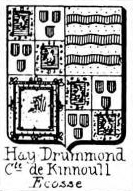
(Earl of Kinnoull). Quarterly, 1st and 4th grand quarters, counterquartered, 1st and 4th, az. a unicorn saliant ar. armed, maned, and unguled or, a border of the last charged with eight demi thistles vert impaled with as many demi roses gu., for augmentation, 2nd and 3rd, ar. three escutcheons gu., for Hay; 2nd grand quarter, counterquartered, 1st and 4th, or, three bars wavy gu. surmounted of a scymitar in pale ar. hilted and pommelled of the field, for Drummond, 2nd and 3rd, or, a lion’s head erased within a double tressure flory counterflory gu. a coat of augmentation, likewise for Drummond. Crest—An aged Lowland Scots countryman couped at the knees, vested in grey, waistcoat gu. bonnet az. bearing on his shoulder an ox-yoke ppr. Supporters— Two young Lowland Scots countrymen habited as the crest, the dexter holding over hia shoulder the coulter of a plough, the sinister a paddle, both ppr. Motto—Renovate animos.
(E. W. Auriol Hay, Lyon Clerk, 1824). Quarterly, 1st, az. a unicorn saliant ar. armed, maned, and unguled or, within a bordure of the last charged with eight half thistles vert impaled with as many half roses gu.; 2nd, or, a lion’s head erased within a double tressure flory counterflory gu.; 3rd, ar. three inescutcheons gu; 4th. or, three bars wavy gu. surmounted of a scymitar in pale ar. hilted and pommelled of the field, all within a bordure gu. Crest and Motto, as Earl of Kinnoull.
(Robert William Hay, Commissioner for Victualling the Navy, 1824). Quarterly, as the last, within a bordure erm. Same Crest and Motto.
(Lochloy, co. Elgin). Ar. three inescutcheons gu. within a bordure of the last. Crest—An ox-yoke erected in pale or, with bows gu. Motto—Serva jugum.
(Strowie, co. Perth). As the last, the bordure charged with eight crescents ar. for diff. Crest—An ox-yoke gu. in pale ensigned with a crescent ar. Motto—Cresco sub jugo.
(Paris, co. Perth, 1778). Ar. a falcon’s head erased betw. three inescutcheons gu. a bordure of the last. Crest—A plough ppr. Motto—Nil desperandum.
(Woodcockdale, co. Linlithgow, 1672; the family afterwards adopted the name of Bruce on marrying the heiress of Kinnaird). Ar. a fess wavy betw. three inescutcheons gu. a bordure of the last. Crest—A demi arm ppr. holding an ox-yoke or, with bows gu. Motto—Hinc incrementum.
(Camber, co. Linlithgow, 1720). As the last, the fess charged with an otter’s head erased ar. for diff. Crest—A dexter arm holding the bow of a plough ppr. Motto—Laboranti palma.
(Monkton, 1672; the heiress m. Mitchelson, of Middleton). Ar. three inescutcheons gu. within a bordure engr. az. powdered with frases of the field.
(Naughton, co. Fife, earliest cadet of Erroll; the property through two female descents came afterwards to Hays of the Megginch branch). Ar. three inescutcheons gu. within a bordure indented of the last.
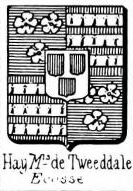
(Locherworth, co. Peebles; Earl and Marquess of Tweeddale). Quarterly, 1st and 4th, az. three cinquefoils ar., for Fraser; 2nd and 3rd, gu. three bare erm., for Gifford, of Yester; over all upon an escutcheon ar. three escutcheons gu., for the paternal coat of Hay. Crest—A goat’s head erased ar. armed or. Supporters—Two bucks ppr. attired and unguled or, each gorged with a collar az. charged with three cinquefoils ar. Motto—Spare nought.
(Newton, co. Haddington). Quarterly, 1st and 4th, the quartered coat of Tweeddale, in the centre a mullet gu. for diff.; 2nd and 3rd, vert a lion ramp, or, on a chief of the last three roses gu., for Newton. Crest—A demi lion ramp. or, brandishing a scymitar ppr. hilted and pommelled of the first. Motto—Pro patria.
(now Baird-Hay, of Belton, co. Haddington). Quarterly, 1st and 4th, the quartered Tweeddale coat within a bordure gu.; 2nd and 3rd, per pale gu. and or, a boar pass, counterchanged, for Baird. Same Crest and Motto as Marquess of Tweeddale.
(Drummelzier). As Marquess of Tweeddale, quartering the arms of Seton, Viscount Kingston (q.v.). Crest and Motto, as Marquess of Tweeddale.
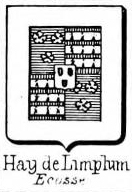
(Linplum, co. Haddington). Quarterly, as Marquess of Tweeddale, within a bordure ar. Crest—A goat’s head erased ar. armed or, and charged with a crescent az. Mottoes—Above the crest: Spare nought; below the arms: Malum bono vince.
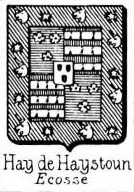
(Smithbfield and Haystoun, co. Peebles, bart. 1683). Quarterly, as Marquess of Tweeddale, within a bordure vert charged with unicorns’ heads couped alternating with mullets ar. Crest—An ox-yoke in bend or, with bows gu. Motto—Pro patria. Supporters—Dexter, a countryman ppr. holding over his shoulders an ox-yoke or, the bows gu.; sinister, a royal stag ppr.
(Craignethan, co. Peebles, cadet of Haystoun). Quarterly, 1st and 4th, az. three frases ar., for Fraser; 2nd, gu. three bars erm., for Gifford; 3rd, vert a unicorn’s head erased ar. en surtout ar. three inescutcheons gu., for Hay.
(Monkton, co. Haddington; heiress m. Sir Alexander Hay, of Whitburgh, descended of Lochloy, v. supra). Ar. three inescutcheons gu. within a bordure engr. az. charged with eight frases of the field.
(Edinburgh, 1672). Quarterly, as Marquess of Tweeddale, differenced by a mullet charged with a crescent in the centre. Crest—A buck’s head cabossed ppr. Motto—Venter and gain.
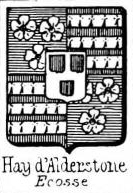
(Alderston, co. Haddington, bart. 1703). Quarterly, as Marquess of Tweeddale, in the centre a key fessways wards downwards sa. Crest—A goat’s head erased as. horned or. Motto—Spare nought.
(Rannes, co. Aberdeen, 1764; represented by Leith-Hay, of Leith Hall, as heir of line; Gordon, of Avochie, the heir male). Quarterly, 1st and 4th, ar. three inescutcheons gu.; 2nd and 3rd, az. three cinquefoils ar., for Fraser; in the centre a crescent for diff. Crest—A goat pass. ar. armed and unguled or. Motto—Spare nought.
(Faichfield and Cocklaw; as recorded for Charles Hay, a judge of the Court of Session, under the title of Lord Newton, 1806). Quarterly, 1st and 4th, ar. three inescutcheons gu.; 2nd and 3rd, az. a chev. erm. betw. three pheons ar. a bordure indented of the third, for Mudie; in the centre of the quarters a crescent gu. Crest—A goat pass, ar. armed and unguled or. Motto—Spare nought.
(Laxfirth, Shetland). Ar. a mullet az. betw. three inescutcheons gu. a bordure of the second. Crest—A goat’s head ar. horned or, charged on the neck with a mullet az. Motto—Malum bono vincitur.
(London, 1672). Ar. three inescutcheons gu. within a bordure counter-compony of the last and first. Crest—A dexter hand holding an ox-yoke ppr. with bows gu. Motto—Valet et vulnerat.
(Leith, 1685). Ar. three inescutcheons gu. each charged with a garb or, banded of the second. Crest—An ox-head couped ppr. Motto—Nec abest jugum.
(Konigsberg, 1807). Ar. three inescutcheons gu. within a bordure engr. sa. charged with eight annulets or. Crest—Two arms from the shoulders embowed vested in russet, grasping an ox-yoke or, the bows gu. Motto—Pro patria.
Gu. on a fesse betw. six martlets ar. two martlets sa. Crest—A hand holding an annulet or.
Ar. a bend sa. an orle of martlets counterchanged.
Ar. a fesse sa. in chief three martlets gu.
Ar. three escallops in bend sa. cotised gu.
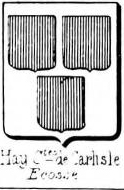
(Earl of Carlisle; created 1622, extinct 1660). Ar. three escutcheons gu.
(Robertsbridge, co. Sussex, temp. Edward IV., and of Glynbourne, in the same county; the last male heir, Thomas Hay, Esq., Lieut-Colonel of the Sussex Militia, and M.P. for Lewes, d. unm. in 1786; the Langhams, of Cottesbrooke, co. Northampton, now represent the Hay family). Ar. on a fesse gu. betw. six martlets sa. two martlets or.
(Tacumshane and Ballinkeele, co. Wexford, a family settled in that co. for several centuries. Visit. 1618). Ar. three inescutcheons gu. Crest—A falcon ar. wings expanded ppr. belled or.
(St. Malo; confirmed by Hawkins, Ulster, 1723, to Edward Hay, Esq., of St. Malo, fourth in descent from Robert Hay, eldest son of Matthew Hat, Esq., of Tacumshane). Same Arms. Crest—A falcon ar. wings expanded ppr. helled or. Motto—Serva jugum.
(Castlebarne, co. Longford; Fun. Ent. of William Hay, of that place, d. March, 1634). Same Arms, a mullet for diff.
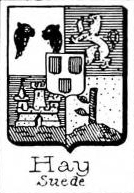
Suède – (Barons, 1815) – Écartelé aux 1 et 4 d’argent à deux têtes de chat affrontées de sable terminées chacune en un demi-vol abaissé du même au 2 d’azur au lion d’or au 3 d’azur à un château d’or posé sur une terrasse de sinople sommé de trois tourelles d’or celle du milieu supérieure les deux autres girouettées d’argent au 4 d’or à un tronc d’arbre au naturel terrassé de sinople et poussant à dextre deux feuilles du même Sur le tout d’argent à trois écussons de gueules Deux casques couronnés Cimiers 1° une aigle au naturel le vol étendu surmontée d’une étoile d’argent et tenant de ses serres deux rubans d’or et d’argent flottant à dextre et à senestre 2° une épée d’argent garnie d’or devant un panache de trois plumes d’autruche une de sable entre deux d’argent le tout entre deux drapeaux d’argent Tenants deux chevaliers armés de toutes pièces coiffés de casques d’or la visière baissée celui à dextre tenant une masse à picotons levée et celui à senestre une massue abaissée
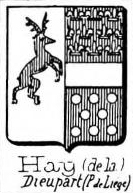
Dieupart (P. de Liège) – Parti au 1 d’argent à un cerf rampant et contourné de gueules au 2 de gueules à la fasce d’argent le gueules en chef semé de fleurs-de-lis au pied coupé d’argent et le gueules en pointe ch de huit besants du même 3 2 et 3 Cimier un cerf issant de gueules
Ecosse – (Baronet, 22 fév. 1703) – Écartelé aux 1 et 4 d’azur à trois quintefeuilles d’argent (Fraser) aux 2 et 3 de gueules à trois fasces d’hermine (Gifford de Yester) Sur le tout d’argent à trois écussons de gueules (Hay) Cimier une tête de bouc d’argent accornée d’or le col ch d’un croissant d’azur Tenants à dextre un paysan tenant un joug d’argent posé sur son épaule à senestre un cerf au naturel colleté et onglé d’or orné d’un collier d’azur ch de trois quintefeuilles d’argent Devise SPARE NOUGHT
Comte de Carlisle – Ecosse – (Baron Hay de Sauley, 29 juin 1615; cicomte Doncaster, 5 juillet 1618; comte de Carlisle 13 sept. 1622. M. ét. en 1660) – D’argent à trois écussons de gueules
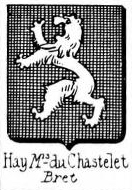
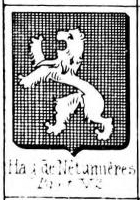
Marquis du Chastelet – Bretagne – (Barons des Nétumières, 1629; marquis du C., 1682; barons de Tizé) – De sable au lion morné d’argent
Comte de Kinnoull – Ecosse – (Baron Hay de Kinfauns et vicomte Dupplin. 4 mai 1627; comte de K., 25 mai 1633; titres dans la pairie d’Ecosse. Baron Hay de Pedwardine, dans la pairie de la Grande-Bretagne, 31 déc. 1711) – Écartelé aux I et IV contre-écartelé aux 1 et 4 d’azur à une licorne saillante d’argent accornée crinée et onglée d’or à la bordure du même ch de huit chardons de sinople et de huit roses de gueules posées alternativement aux 2 et 3 d’argent à trois écussons de gueules au II d’or à trois fasces ondées de gueules au III d’or à une tête de lion de gueules enclose dans un double trêcheur fleuronné et contre-fleuronné du même Cimier un paysan issant habillé au naturel tenant un joug posé sur son épaule Tenants deux paysans celui à dextre tenant un soc de charrue Celui à senestre une bêche posés sur leur épaule Devise RENOVATE ANIMOS
Comte d’Erroll – Ecosse – (Baron Hay de Slains et comte d’E., dans la pairie d’Ecosse. 17 mars 1452; baron Kilmarnock, dans la pairie du Royaume-Uni, 31 mai 1831) – D’argent à trois écussons de gueules Cimier un faucon essorant au naturel Tenants deux paysans tenant chacun un joug posé sur son épaule Devise SERVA JUGUM
Ecosse – (Baronet, 20 juillet 1635) – Écartelé aux 1 et 4 d’azur à trois quintefeuilles d’argent (Fraser) aux 2 et 3 de gueules à trois fasces d’hermine (Gifford de Yester) L’écu entouré d’une bordure de sinople ch alternativement de têtes de licorne d’argent et d’étoiles rayonnantes du même Sur le tout d’argent à trois écussons de gueules (Hay) Cimier un joug d’argent posée en bande Tenants à dextre un paysan tenant un joug d’argent posé sur son épaule à senestre un cerf au naturel Devise PRO PATRIÂ
Ecosse – (Baronet, 1667. M. ét. en 1751) – Écartelé aux 1 et 4 d’azur à trois quintefeuilles d’argent (Fraser) aux 2 et 3 de gueules à trois fasces d’hermine (Gifford de Yester) L’écu entouré d’une bordure d’argent Sur le tout d’argent à trois écussons de gueules (Hay) Cimier une tête et col de bouc d’argent accornée d’or ch d’un croissant d’azur Devise MALUM BONO VINCE
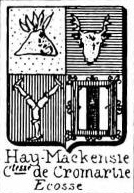
Comtes de Cromartie – Ecosse
Bretagne – De sable au lion morné d’argent
Ecosse – (Baronet, 25 août 1663) – D’argent à trois écussons de gueules à la bordure du même Cimier un faucon au naturel le vol levé Devise SERVA JUGUM
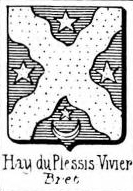
Bretagne – D’azur au sautoir ondé d’or cantonné de quatre étoiles du même celle en pointe soutenue d’un croissant d’argent
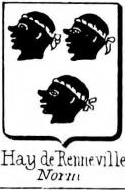
Normandie – D’argent à trois têtes de More
Bretagne – D’argent à trois écussons de gueules Devise RENOVATE ANIMOS
Marquis de Tweeddale – Ecosse – (Lord Hay de Yester, 29 janv. 1487-88; comte de Tweeddale, 1 dec. 1646; vicomte Walden, comte de Gifford et marquis de T., 17 déc. 1694; titres dans la pairie d’Ecosse; baron Tweeddale de Yester, dans la pairie du Royaume-Uni, 6 oct. 1881) – Écartelé aux 1 et 4 d’azur à trois quintefeuilles d’argent (Fraser) aux 2 et 3 de gueules à trois fasces d’hermine (Gifford de Yester) Sur le tout d’argent à trois écussons de gueules (Hay) Cimier une tête et col de bouc d’argent accornée d’or Supports deux cerfs au naturel ramés et onglés d’or ornés chacun d’un collier d’azur ch de trois quintefeuilles d’argent Devise SPARE NOUGHT